Want to better understand how the health and social systems work and how you can better advocate for changes that would improve these systems for you and your family? Enhance your knowledge with one of our free courses for citizens:
Finding and using research evidence: A guide for citizens
In this free online course, you’ll be provided with solutions to overcome the most commonly cited frustrations people have when trying to access research evidence. Prepared by the McMaster Health Forum with support from the Ontario SPOR SUPPORT Unit, the course is now available online as a set of eight videos:
Here are helpful resources that are drawn on in the course:
- Definitions for word and phrases used in the modules
- How to make sure health information is trustworthy
- Links to online sources mentioned in the modules
Don’t miss the most important resource for citizen-targeted evidence about healthy aging:
Understanding how to navigate the health system
Knowing how your health system works will better you to navigate the system, identify opportunities to make things better, and advocate for changes that you’d like to see. This free online course describes the 'building blocks' of Ontario’s health system as well as how those building blocks are used to provide care in the province in different ways (e.g., by sector, condition, treatment, population). While Ontario is the example, these principles are useful to understanding health systems other jurisdictions in Canada and internationally.
Prepared by the McMaster Health Forum with support from the Ontario SPOR SUPPORT Unit, the course is now available online as a set of six videos:
Here are helpful resources that are drawn on in the course:
- Free download of chapters from Ontario’s Health System: Key Insights for Engaged Citizens, Professional and Policymakers. The Ontario book is also helpful in understanding other health systems
Don’t miss the most important resource for citizen-targeted evidence about healthy aging:
Masterclass on patient-oriented research
The Forum’s masterclass was designed to prepare future champions for the conduct and use of patient-oriented research and future mentors to others becoming involved in the conduct and use of patient-oriented research. While we are not currently planning any sessions for the masterclass on patient-oriented research, you can access all of the course material to learn more about patient-oriented research.
Forum welcomes fellows for 2017-18
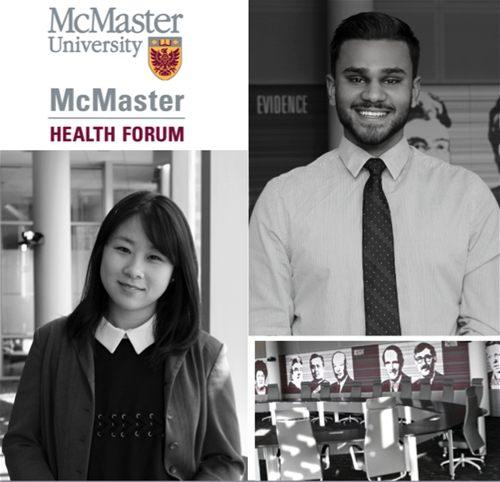
The McMaster Health Forum is pleased to announce that Puru Panchal and Fanny Cheng have been selected as Forum Fellows for the 2017-18 academic year. The Forum Fellows program is part of our commitment to prepare action-oriented leaders in addressing pressing health challenges creatively. Each fellow will have the opportunity to support various Forum initiatives, interact with regional, provincial and international health systems stakeholders, and will end their fellowships with an internship through the Queen Elizabeth Scholarship program.
Fanny and Puru are both entering their third year in the Global Health Specialization within the Bachelor of Health Sciences Program. They have both been involved in a number of university-based research projects and community initiatives that have sparked their interests in health systems reform and strengthening.
Puru’s interests in global health stem from his research engagements in cardiovascular health and adverse childhood experiences. Through his studies, he became interested in the various social, cultural and economic conditions that influence patient care in clinical settings. Through his research and community engagements, he has broadened his interests to the level of health systems. Over the summer, Puru will be working at the McMaster Health Forum and Impact Lab and will further explore cardiovascular disease as a research student in the Heart Investigation Unit at Hamilton General Hospital. Working with faculty from the Harvard T.H. Chan School of Public Health, Puru hopes to better understand the complexities of preparing health systems for chronic-disease management and the integration patient perspectives to better inform shared decision-making.
While Fanny began her studies with a rather quixotic view of public health, she has since embraced its gritty complexities and adopted a more practical perspective. This transformation was aided by her various volunteer commitments and her two summers with the Ontario Public Service, where she saw how policies and systems are developed and translated to intended and unintended impacts on individual behaviours. Fanny looks forward to getting involved with the process of translating research to decisions, policies, and programs. She is particularly interested in exploring both reproductive health and healthcare barriers for marginalized populations. She will spend the summer before her fellowship working at the Forum and the Impact Lab.
Both students have diverse leadership experiences with student-based organizations and hope to engage McMaster students in the vast number of opportunities offered by the Forum, including student-led events, courses, and simulation activities.
The fellowships begin in September 2017 and will culminate in a summer internship on the front lines of health system decision-making, working at organizations such as provincial or federal governments, or the World Health Organization.

- McMaster Forum