Want to better understand how the health and social systems work and how you can better advocate for changes that would improve these systems for you and your family? Enhance your knowledge with one of our free courses for citizens:
Finding and using research evidence: A guide for citizens
In this free online course, you’ll be provided with solutions to overcome the most commonly cited frustrations people have when trying to access research evidence. Prepared by the McMaster Health Forum with support from the Ontario SPOR SUPPORT Unit, the course is now available online as a set of eight videos:
Here are helpful resources that are drawn on in the course:
- Definitions for word and phrases used in the modules
- How to make sure health information is trustworthy
- Links to online sources mentioned in the modules
Don’t miss the most important resource for citizen-targeted evidence about healthy aging:
Understanding how to navigate the health system
Knowing how your health system works will better you to navigate the system, identify opportunities to make things better, and advocate for changes that you’d like to see. This free online course describes the 'building blocks' of Ontario’s health system as well as how those building blocks are used to provide care in the province in different ways (e.g., by sector, condition, treatment, population). While Ontario is the example, these principles are useful to understanding health systems other jurisdictions in Canada and internationally.
Prepared by the McMaster Health Forum with support from the Ontario SPOR SUPPORT Unit, the course is now available online as a set of six videos:
Here are helpful resources that are drawn on in the course:
- Free download of chapters from Ontario’s Health System: Key Insights for Engaged Citizens, Professional and Policymakers. The Ontario book is also helpful in understanding other health systems
Don’t miss the most important resource for citizen-targeted evidence about healthy aging:
Masterclass on patient-oriented research
The Forum’s masterclass was designed to prepare future champions for the conduct and use of patient-oriented research and future mentors to others becoming involved in the conduct and use of patient-oriented research. While we are not currently planning any sessions for the masterclass on patient-oriented research, you can access all of the course material to learn more about patient-oriented research.
Expanding the scope of Social Systems Evidence
With a growing international focus on evidence-informed policymaking to achieve the UN’s Sustainable Development Goals (SDGs), we’re excited to announce that we’ll soon be expanding the scope of Social Systems Evidence (SSE) to cover all of the SDGs. This expansion of SSE is made possible by an exciting partnership with the Monash Sustainable Development Institute (MSDI).
“For all those looking for evidence to support policy decisions, we’re trying to help you do this better or more efficiently,” said John N. Lavis, Director of Forum+, which is an initiative of the McMaster Health Forum that extends its reach beyond the health sector. “We’re really excited about this partnership with MSDI, which is internationally recognized for its expertise in addressing the SDGs – especially those focused on energy, the environment and climate change.”
Chair of Monash Sustainable Development Institute John Thwaites is also enthusiastic about the potential of the partnership. "As Co-Chair of the Leadership Council of the Sustainable Development Solutions Network, I see great potential in connecting this world-first evidence resource to the 700+ university members of the SDSN. The SDSN member regions and universities are all engaged in the challenge of how to best use evidence to address the SDGs"
For Associate Professor Peter Bragge, who is academic lead of the partnership, the partnership cements an ongoing collaboration with the McMaster team. "Having pioneered and applied the Forum approach in Australia with great support from John Lavis and his team since 2012, this seems a logical next step in our shared goal of bringing the world's best evidence resource to those who need to address complex challenges"
Social Systems Evidence is already the world’s most comprehensive, free access point for synthesized evidence about strengthening 16 government sectors and program areas. These program and service areas currently cover most of the SDGs, with the exceptions of the health part of goal 3 (which is already well covered by three existing online repositories, namely ACCESSSS for clinical evidence, Health Evidence for public health evidence, and Health Systems Evidence for evidence about how to organize ourselves to get the right health programs and services to those who need them), most of goal 7 (energy); and all of goals 13-15 (climate, water and land). Through this new partnership, MSDI will broaden the number of government sectors and program areas covered and specifically identify, appraise and curate systematic reviews pertaining to SDGs 7 (Affordable and Clean Energy), 13 (Climate Action), 14 (Life Below Water) and 15 (Life on Land).
Register for a free account and stay informed on content that matters to you. Browse a list of new reviews added in the past month.
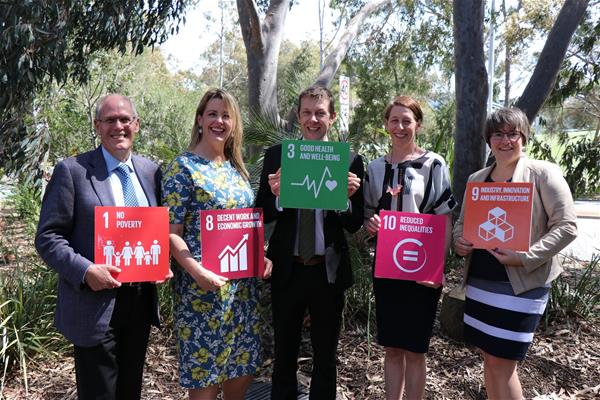
Pictured above (left to right)
- David Farrar, Provost and Vice-President (Academic) McMaster University
- Rebekah Brown, Senior Vice-Provost & Vice-Provost (Research) and Director of Monash Sustainable Development Institute, Monash University until Nov 2018
- Peter Bragge, Lead of MSDI-SSE collaboration and Director of Health Programs, BehaviourWorks Australia, Monash Sustainable Development Institute, Monash University
- Michelle Armstrong, Chief Operating Officer, Monash Sustainable Development Institute, Monash University
- Karen Mossman, Associate Vice-President, Research, McMaster University
Photo taken at Monash Sustainable Development Institute, Monash University by Geoff Paine
- McMaster Forum